
If you run a business in Toronto, chances are your name, address, and phone number are already scattered across dozens of websites, some correct, some outdated, some just plain wrong. Most business owners never notice until a customer mentions calling an old number, or until rankings quietly stall for no obvious reason. That’s what local citation building is really about: making sure every mention of your business online tells the same, accurate story.
At Rank Maple, we handle local citation building services for Toronto businesses the honest way. We won’t tell you that citations alone will shoot you to the top of Google Maps overnight. What we will tell you is that fixing wrong, missing, or inconsistent listings removes a quiet drag on your rankings that most businesses don’t even know is there, and that’s real, measurable value.
Quick Answe
A local citation is any place online where your business Name, Address, and Phone number (NAP) show up together. You’ll find citations on directories, review sites, maps apps, and industry platforms. There are two kinds: structured citations, which live in a clear template like a Google Business Profile or Yelp page, and unstructured citations, which are organic mentions in blog posts, news articles, or sponsorship pages that you can’t submit directly.
Why citations still matter for local search rankings
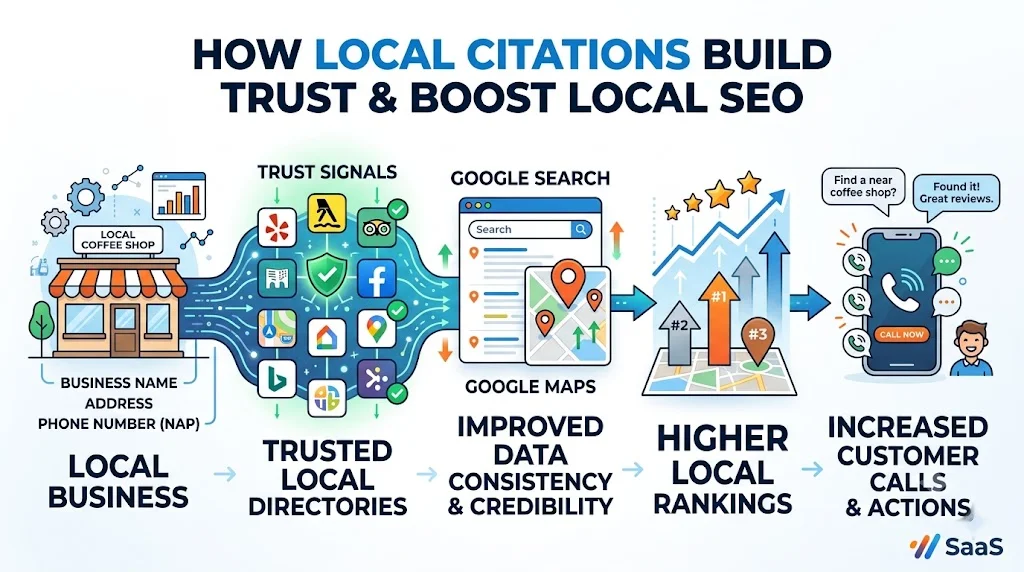
Google uses three main things to decide who shows up in local search results: how close a business is to the searcher, how well it matches what they’re looking for, and how well-known and trusted the business appears to be. Citations feed directly into that third factor: trust, or what the industry calls prominence.
Here’s the simple version of why this works: search engines don’t have a master list that confirms your business is real. They build a picture from every source they can find and decide how confident they are in it. If fifteen different websites all say the same thing about your business, that’s a confident, trustworthy record. If those same fifteen sources say four different things, the algorithm can’t be sure what’s true, so it plays it safe and trusts you less.
This is why accuracy matters more than the small formatting details people used to worry about. A slightly different way of writing “Street” versus “St.” rarely causes real problems anymore. A wrong phone number, a wrong postal code, or an old address that no longer applies? That’s a real problem, and it confuses both search engines and actual customers trying to reach you.

Citations and AI search: why this matters more now, not less
Over the past couple of years, the way people search has genuinely changed. Google’s AI Overviews and tools like ChatGPT don’t just hand back a list of ten blue links anymore. They read information from multiple sources directories, review platforms, business websites and put together a direct answer.
This changes the stakes. A normal search ranking issue might put you at position eight instead of position three; annoying, but you’re still there. An AI-generated answer either names your business, or it doesn’t. If the AI scans your listings and finds conflicting information, the safest thing for it to do is recommend a competitor whose details all agree with each other. Your business simply doesn’t get mentioned.
That’s why unstructured citations real mentions in blog posts, local news, and community pages carry extra weight now. AI systems are looking for proof that real people and real sources are talking about your business consistently, not just that you’ve filled out a form on fifty directory websites.
What citations can actually do and what they can’t
We think it’s worth being upfront about this, because a lot of agencies oversell citation work. Citations will not save a business with a weak website, no reviews, and nothing that makes it stand out locally. If your online presence has bigger problems, fixing your citations first is like painting over cracks in a wall instead of fixing the foundation.
What citations genuinely do is remove friction. They stop wrong or conflicting information from actively working against you. A business with fifty accurate, relevant listings and a solid website will consistently outperform a business with three hundred scattered, inconsistent ones. Think of citations as the floor necessary to stand on, but not the whole building. If any agency tells you citation building alone guarantees a jump to the top of Google Maps, that’s not an honest claim.

Our tiered approach to citation building
in Toronto
Volume stopped being the goal a long time ago. Thirty to fifty accurate, relevant listings will outperform three hundred random ones every time. That’s why we work in tiers, and finish each one properly before starting the next.
Tier 1 — Core platforms
The non-negotiable foundation: Google Business Profile, Bing Places, Apple Business Connect, Yelp, and Facebook. Google Business Profile matters most by far nothing else compensates for a weak or unclaimed profile here. We claim these directly with your login, not through a third-party tool, because you should own the access.
Tier 2 — National Canadian directories
Sites like YellowPages.ca, Canada411, N49, and the Better Business Bureau give you broad, stable Canadian coverage. N49 is a genuinely Canadian directory with strong local organization, and the BBB still carries real weight for higher-consideration purchases.
Tier 3 — Industry-specific directories
This is where a lot of the real value sits, and it’s the tier most businesses skip entirely. A renovation company gets more from one complete HomeStars profile than from twenty generic listings combined, because that’s where the buying decision actually happens. The same logic applies to Houzz for design and build firms, RateMDs for medical practices, and industry association directories, which tend to be manually reviewed and hard for competitors to copy.
Tier 4 — Local and community listings
Business Improvement Area (BIA) pages, chamber of commerce directories, and neighbourhood association listings are individually small but collectively powerful. They’re also where unstructured, organic mentions tend to come from the kind that carry extra weight with both search engines and AI tools.
Local citation building for service-area businesses
If you don’t operate out of a public storefront, say you’re a plumber, an HVAC company, or a mobile service provider, your citation strategy needs to work differently.
We set your Google Business Profile up correctly as a service-area business, which lets you hide your physical address from public view while still telling Google exactly which cities and neighbourhoods you cover. This matters because listing too many service areas in an attempt to “cover more ground” almost always backfires; it dilutes your relevance instead of expanding it. A tightly defined, accurate service area consistently outperforms an inflated one.
What goes wrong with citations, and how we fix it
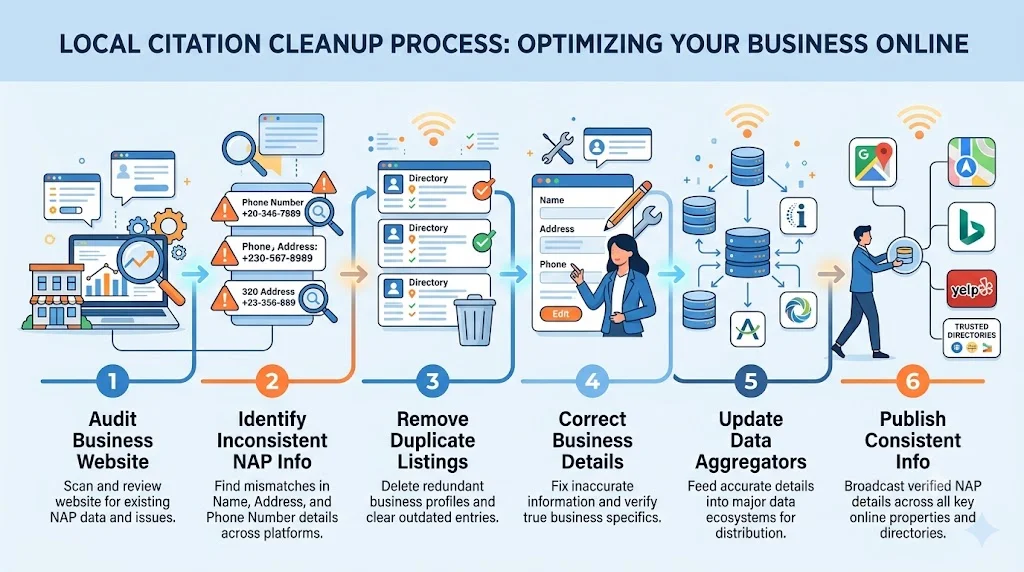
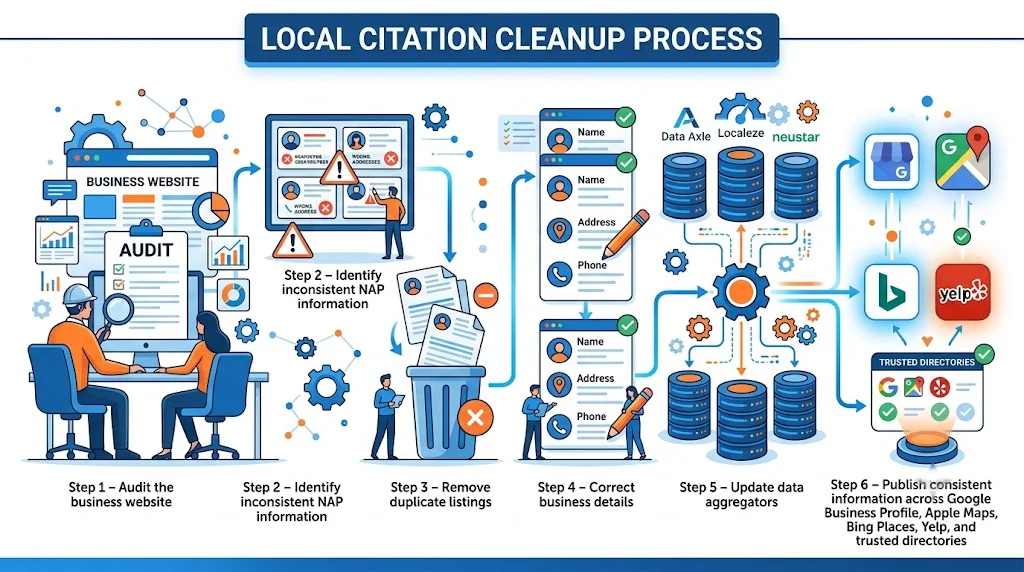
The most common problem we find during a citation audit has nothing to do with directories at all. It’s the business’s own website. A footer with one address, a contact page with a different one, and a careers page with a third every one of those inconsistencies gets copied by directories that scrape data automatically, so the error spreads outward from the source.
Duplicate listings are the other big issue. When a business moves, rebrands, or changes its phone number, old listings often don’t disappear; they just sit there, out of date, sometimes still collecting reviews for a location or number that no longer applies. Search engines get confused when they find two listings for what should be one business, and the confusion works against your ranking rather than for it.
Data aggregators add another layer worth understanding. These are companies that feed your business information into hundreds of smaller directories automatically, which sounds efficient and often is, but it also means a wrong detail spreads fast once it enters the system. We always lock down your correct information first, then use aggregators to spread the good version, not the other way around. Our process starts with fixing your own website, then auditing what already exists, including listings you didn’t even know were live before building anything new.
Owning your citations
Owning your citations versus renting them
There are two very different ways citation services work, and the difference matters more than most people realize when they’re comparing prices.
Manual building
means someone submits and verifies each listing individually. It takes longer upfront and costs more per listing, but once it’s done, it’s yours permanently. Nobody can take it away by cancelling a subscription.
The Instant Answer
Sync services
Push your business data out automatically through an ongoing connection, and updates show up everywhere within minutes. That convenience comes with a catch: the moment you stop paying, the connection releases, and directories can quietly drift back toward old, incorrect data over time. For most Toronto small businesses, a one-time manual build that you own outright makes more sense.
business citation Services
What’s included in our local citation services
Citation audit
Finding every existing listing, including ones nobody at your business created
citation cleanup service
Locking down one accurate version, then correcting every listing to match
Core platform setup
GBP, Bing Places, Apple Business Connect, Yelp, Facebook, claimed with your login
National & industry submissions
Built around relevance, not padded for volume
Local Toronto listings
BIA pages, chamber of commerce, neighbourhood associations
Duplicate listing cleanup
So old versions don’t confuse search engines or split your reviews
Ongoing monitoring
A quarterly check-in to catch drift before it becomes a problem again
FAQ